

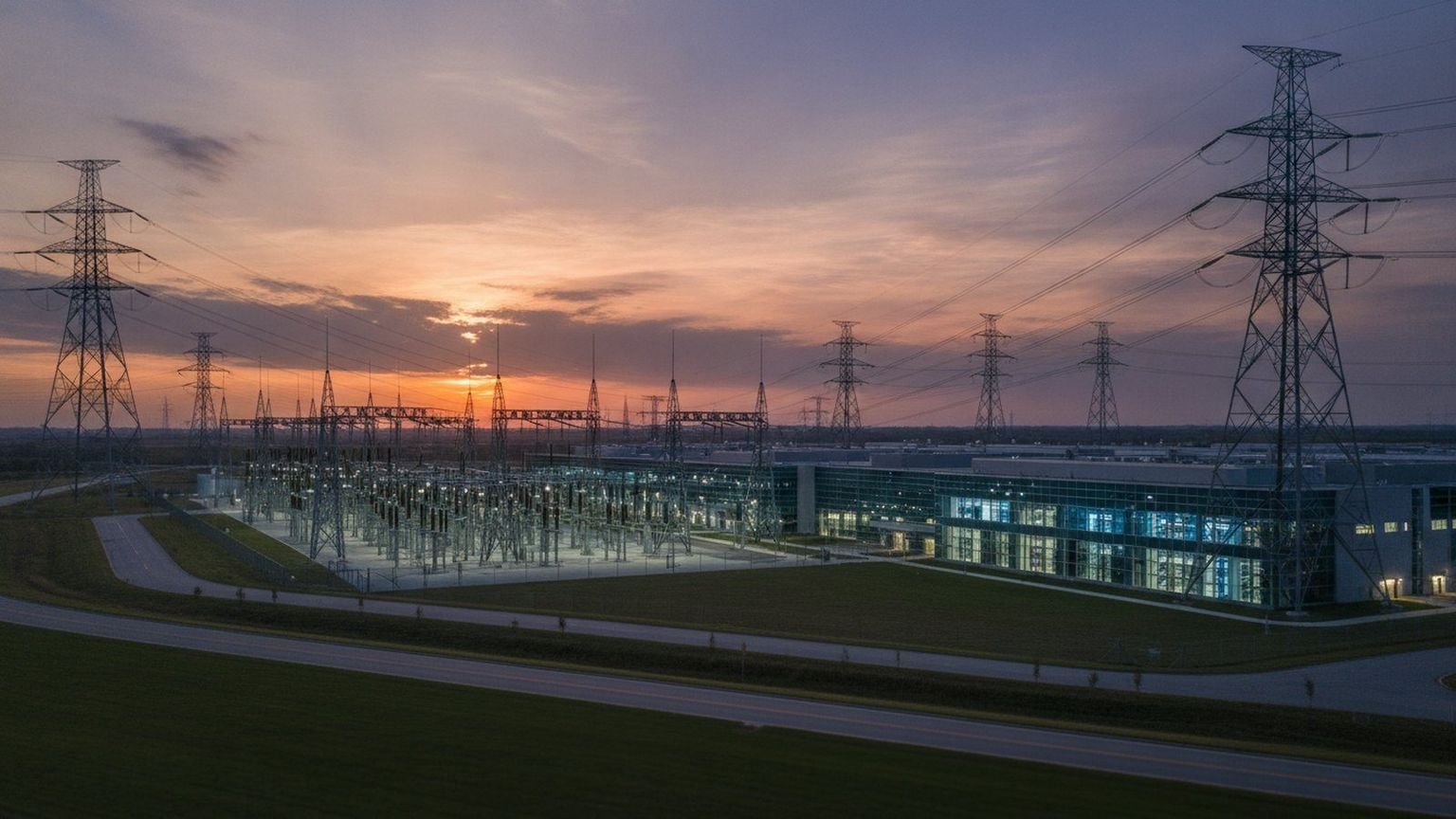
The capacity question has changed shape. For a decade, the constraint on cloud expansion was silicon, land, and capital. Now, in a growing number of markets, it is the date on which a substation can be energized. That is a different kind of constraint: it is local, it is slow, and it does not respond to spending in the same quarter. The cost of that constraint reaches customers through utilization, contract structure, and region selection long before it shows up as a line item called power.
This matters for planning because the usual instinct, waiting for published price changes, is too late. Providers buy power and capacity years ahead. By the time an on-demand rate moves, the siting decision that caused it was made several budget cycles earlier, and the workaround you want may already be sold out.
Power is a siting constraint before it is a price
Lawrence Berkeley National Laboratory's 2024 report on US data center energy use estimated that data centers consumed about 4.4 percent of US electricity in 2023 and projected a range of roughly 6.7 to 12 percent by 2028, depending on how fast accelerated computing scales. The range is wide because the outcome depends on deployment, not on demand for the service. Whichever end you believe, the growth is concentrated in a handful of grid regions that were not planned for it.
Those regions have three separate bottlenecks, and they resolve on different timelines. Interconnection is the queue to connect a large load to the transmission system, and it is measured in years. Equipment is the transformer, switchgear, and turbine supply chain, which is also measured in years and is booked out well ahead. Local approval is zoning, water rights, and community consent, which has no predictable timeline at all. A project needs all three, so the slowest one sets the date.
Three bottlenecks, three different clocks
Interconnection is the one most often misread. A developer can hold a queue position and still lose it, because the queue is a study process rather than a reservation, and projects that withdraw late can push everyone behind them. This is why announced capacity and delivered capacity diverge so sharply. For a cloud customer, the practical implication is that a new region or availability zone announced with a target year should be treated as a range, not a date.
Equipment lead times are less visible and just as binding. A large power transformer is a custom engineered object, not a catalog item, and the order book for high-voltage equipment tightened across the industry as grid investment rose. Local approval is the wildcard that can zero out a site after the other two clear, which is why water use and noise have become board-level topics in some markets.
What PPAs and nuclear deals actually change
A power purchase agreement fixes the price of energy for a defined term. It does not create electrons at the moment you need them, does not add transmission capacity, and does not shorten an interconnection queue. What it does is transfer fuel and market price risk from the operator to the contract, which is genuinely valuable when wholesale prices are volatile, and it supports the renewable-energy claims that enterprise customers increasingly ask for.
Nuclear announcements follow the same logic with a longer fuse. Small modular reactors are attractive on paper for firm, carbon-free baseload at the point of consumption, and the Department of Energy has funded the design and licensing work. But no SMR design has a track record of commercial operation in the United States, licensing is a multi-year process, and first-of-a-kind construction schedules have historically slipped. A reactor announced in 2026 is a 2030s source of power, not a 2027 answer. Treat those announcements as evidence of a provider's long-term intent, not as near-term capacity.
Cooling and utilization are the levers providers control fastest
Accelerated racks changed the thermal problem. A rack that draws tens of kilowatts cannot be cooled by moving more cold air through the same aisle, which is why direct-to-chip liquid cooling and immersion have moved from experiments to procurement. Cooling efficiency is expressed as power usage effectiveness, the ratio of total facility power to the power that reaches computing equipment. Lower is better, and the gap between a mediocre facility and a well-designed one is large enough to change the economics of a region.
Utilization is the quieter lever. Every provider runs a mix of workloads with different tolerance for interruption, and the same megawatt serves more revenue when it is packed with work that can be scheduled. This is why interruptible capacity and spot markets exist, and why the discount is real. It is also why efficiency gains at the facility level can be invisible to you: they improve the provider's margin before they improve your rate.
Behind-the-meter generation and demand response belong to the same family. If a facility can curtail load during a grid event or supply some of its own power, the provider turns a reliability problem into a contract with the local utility. Those arrangements take years to negotiate and are rarely announced in detail, but they show up in where capacity grows. When one region keeps adding capacity while a neighbor stalls, the difference is often a power contract rather than land or fiber.
The cost drivers that reach your bill
| Driver | Direction on cost | Typical lag to customer pricing | What to watch |
|---|---|---|---|
| Interconnection queue delays | Upward, through scarcity of new capacity | One to three years | Region launch slips; new instance families land elsewhere first |
| Transformer and switchgear lead times | Upward, through project cost per megawatt | One to two years | Provider capital expenditure guidance and construction timelines |
| Power purchase agreements | Neutral to downward, at the cost of fixed commitments | Contract term, often ten years or more | Renewable energy claims; long-dated contract disclosures |
| Small modular reactors | Potentially downward after 2030 | 2030s | Licensing milestones, not press releases |
| Cooling efficiency (PUE) | Downward where liquid cooling is deployed | One refresh cycle | Accelerated instance availability by region |
| Utilization and scheduling | Downward for interruptible work | Immediate, if you opt in | Spot and interruptible discounts versus on-demand rates |
| Local approval and water constraints | Upward, through site scarcity | Unpredictable | Which regions stop announcing new capacity |
What this means for your cloud bill
Three effects are worth planning for. First, price dispersion between regions widens. Power is a larger share of the cost stack than it used to be, so regions with cheap, available power will look different from regions with constrained grids, and the difference will show up in committed-use discounts as much as in list prices.
Second, commitment products get less flexible before they get more expensive. When capacity is tight, providers prefer longer commitments and are less generous with short-term flexibility. That is a quiet change in contract terms rather than a headline rate increase. Third, the discount for interruptible and batch-friendly workloads grows, because it lets the provider improve utilization. If a meaningful share of your workload is fault tolerant, that is the cheapest capacity you will find.
A worked example makes the shape concrete, with assumptions labeled as such. Assume a rack drawing 40 kilowatts of compute power at a facility PUE of 1.3, so about 52 kilowatts at the meter, running 8,000 hours a year. That is roughly 416,000 kilowatt-hours annually for one rack. At an industrial rate of 8 cents per kilowatt-hour, the energy cost is about $33,000 a year for that rack; at 12 cents, about $50,000. Neither figure is a cloud price, because the provider also pays for the grid connection, the capacity reservation, cooling capital, and land. The point is the sensitivity: a four-cent swing in the underlying rate moves the annual energy cost of a single rack by about $17,000, and that is why siting decisions now look like procurement decisions.
What to do next
- Map your workload's region concentration and identify which regions depend on grids with long queues. Assume new capacity there arrives late rather than early.
- Price a two-region architecture for anything with a 2027-2028 deadline, and treat the second region as insurance rather than redundancy theater.
- Review commitment terms for flexibility language, not just discount depth. Tight capacity markets favor providers who lock in duration.
- Move fault-tolerant batch work to interruptible capacity and measure the realized discount per workload.
- Discount nuclear and SMR announcements in near-term plans; track licensing milestones instead of press releases.